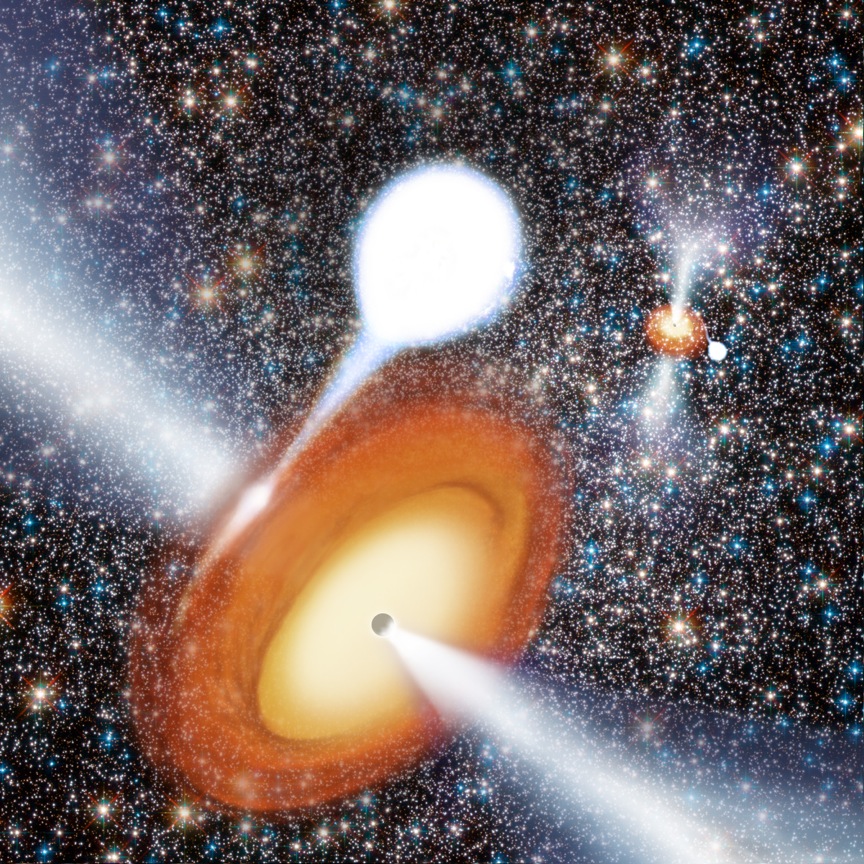
The black hole discovery around our galaxy’s center has astonished astronomers, revealing unexpected features that challenge existing theories.
What did the James Webb telescope find?
The recent findings from the James Webb Space Telescope have sparked excitement in the scientific community, particularly regarding our galaxy’s black hole discovery. This groundbreaking telescope has revealed surprising new details about the black hole at the center of the Milky Way, known as Sagittarius A*.
Among the most intriguing discoveries is the presence of a swirling disk of gas and dust surrounding the black hole. This intense activity suggests that the black hole is more dynamic than previously thought. Scientists were taken aback by the vast amounts of material being pulled into the black hole, which has implications for understanding its growth and influence on surrounding stars.
Additionally, the James Webb telescope identified numerous young stars in close proximity to the black hole, indicating that the environment is conducive to star formation. This discovery challenges previous assumptions about the hostile nature of areas near a black hole.
As researchers continue to analyze the data collected by the telescope, they aim to uncover further insights into the mysteries of black holes. The ongoing exploration promises to enhance our understanding of these cosmic giants and their role in the evolution of galaxies.
Implications of the black hole discovery
The recent black hole discovery has profound implications for our understanding of the universe. As scientists delve deeper into the findings from the James Webb telescope, several key areas of research are emerging.
- Understanding Gravity: The black hole discovery challenges existing theories about gravity and its behavior near such massive objects. Researchers are eager to explore how these forces interact and influence nearby celestial bodies.
- Galaxy Formation: This discovery may reshape our understanding of how galaxies, including our Milky Way, form and evolve. The presence of a black hole at the center could play a crucial role in regulating star formation.
- Dark Matter and Energy: Investigating the dynamics surrounding this black hole may provide insights into the elusive components of dark matter and dark energy, which constitute a significant portion of the universe’s mass-energy content.
- Testing General Relativity: The findings provide a unique opportunity to test Einstein’s theory of general relativity in extreme conditions, offering potential for groundbreaking advancements in physics.
Overall, the implications of the black hole discovery extend far beyond our galaxy, hinting at a more intricate cosmic tapestry than previously imagined.
How does this change our understanding of galaxies?
The recent black hole discovery has profound implications for our understanding of galaxies and their formation. Traditionally, black holes were seen as isolated entities, but new findings suggest they play a crucial role in shaping their host galaxies.
One of the most exciting aspects of this discovery is how it alters our perception of the relationship between black holes and galaxy evolution. Researchers have identified that black holes may influence star formation rates and the distribution of matter within galaxies. This interaction can lead to:
- Regulation of star formation: The energy emitted from matter falling into black holes can heat the surrounding gas, preventing it from collapsing into new stars.
- Galactic structure: The presence of a supermassive black hole at the center of a galaxy can affect its overall dynamics and morphology.
- Feedback mechanisms: Black holes can drive outflows of gas, redistributing material and aiding in the evolution of the galaxy.
As scientists continue to analyze the data from the James Webb telescope, the revelations from this black hole discovery will likely reshape current models of galaxy formation and evolution, pushing the boundaries of our cosmic knowledge.
Future explorations of black holes
The recent black hole discovery has opened up new avenues for exploration and research in astrophysics. As scientists continue to analyze the data gathered by the James Webb Space Telescope, future missions are being planned to delve deeper into the mysteries surrounding black holes.
Upcoming explorations will focus on several key areas:
- Understanding formation: Researchers aim to study how black holes form and grow, providing insights into their lifecycle and the role they play in the evolution of galaxies.
- Gravitational waves: Future missions will also concentrate on detecting gravitational waves generated by black hole mergers, enhancing our understanding of their interactions.
- Event horizon observations: Advanced telescopes will seek to capture images of black holes’ event horizons, allowing scientists to investigate the effects of extreme gravity on surrounding matter.
- Dark matter connections: The relationship between black holes and dark matter will be explored further, potentially revealing how these phenomena influence cosmic structures.
With the black hole discovery, the scientific community is eager to expand its knowledge and unravel the complexities of the universe, paving the way for groundbreaking advancements in our understanding of space.
By Benjamin de Bivort; Strader, et al.; NRAO/AUI/NSF via Openverse
Read the original
Chinese AI startup: Is DeepSeek’s $15 billion raise worth it? · LiteLLM Release Pipeline Faces Serious Credential Theft Risk · OpenAI models: What are the best proven options available?